Showing posts with label America. Show all posts

Monday, 30 January 2012

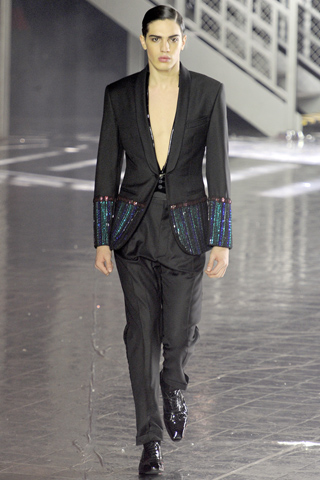
John Galliano the Fashion Icon


Galliano's full name is Juan Carlos Antonio Galliano-Guillén. He was born in Gibraltar to a Spanish mother, Anita and has two sisters. Galliano's father was a plumber. His family moved to England in pursuit of work when Galliano was six and settled in Streatham, South London, before moving to Dulwich and later to Brockley. He was raised in a strict Roman Catholic family which made him shy and different from others making it a struggle to fit in. Recalling his early days, he once admitted: "I don’t think people here understood where I was coming from." His mother, a Flamenco  teacher, would dress him in his "smartest" outfit even for a trip to the local shops.


Thirties-inflected chiffon cut on the bias are among Galliano's signatures, as have been imaginative hats made in collaboration with Stephen Jones. From Yemeni tribes to a camp California Valley of the Dolls, no reference was too far-flung for a Galliano interpretation. This cultural omnivorousness makes an ironic counterpoint to reports of his recent behavior. 

 John Galliano shows and John Galliano characters—including, might as well add, John Galliano himself—tend to be drawn a bit larger than life. Bill Gaytten, now stewarding the house, must be intimately familiar with this. And for his new thirties-inspired show, he looked to the work of J.C. Leyendecker and Norman Rockwell, illustrators for the famous Saturday Evening Post covers of the era. Their men were supermen, too. Call it a tip of the hat from one fabulist to his fellows.


Thursday, 26 January 2012

Fashion Icon Mary Quant MiniSkirt


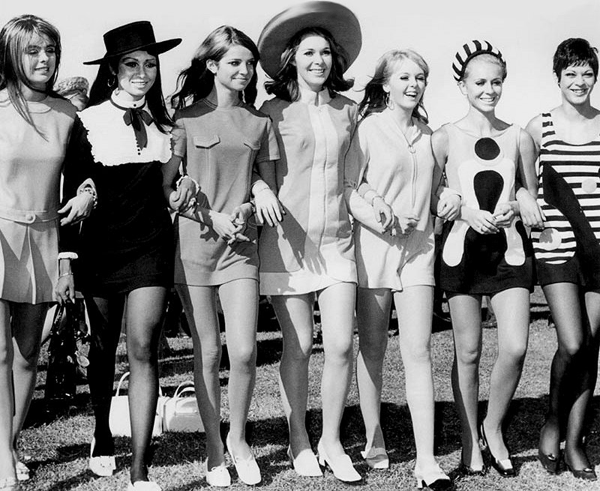
Mini Skirt of Mary Quant (Born 11February 1934) is a Welsh fashion designer and British fashion Icon,who was one of the designers who took credit for inventing the miniskirt and hot pants in 1960s. She brought fun and fantasy to fashion and showed  a generations how to dress to please themselves . 

Miniskirts had been getting shorter since about 1958. Mary Quant considered to be practical  and liberating ,allowing women the ability to run for a bus. The mini skirt which she is arguably most famous for,became one of the defining fashions of the 1960s. The Miniskirt was developed separately by Andre Courreges the french designer, and there's disagreement as  to who  came up with the idea first like most fashions.    
  .
 Quant was not afraid of novelty and experimentation . Some of her most popular designs were sweater dresses with plastic collars , balloon -style dresses, and knickerbockers and stretch stockings in all colours and pattems. Other typical designs included knee-length white plastic lace -up boots and tight sweaters in bold stripes. 

These clothes become part of the London look.

Wednesday, 25 January 2012

History of the Bob Haircut


BOB History ...
Hairstyles of the 1920s created more controversy in hair fashion than in any other period of American culture.  And one hairstyle, known simply as ¾“the bob,” would be at the centre of this great debate.  First introduced during the Great War, the bob haircut would eventually cause a revolution in the way women would wear their hair ¾forevermore. 
                                                                   Louise Brooks

Women in the west have usually worn their hair long. Although actresses and a few advanced or fashionable women had worn short hair even before Word War l -for example in 1910 the French actress Polaire is described as having a shock of short dark hair  a cut she appears to have adopted in early 1890s. The style was not considered respectable until given impetus by the inconvenience of long hair to girls engaged in war work. Renowned dancer and fashion trendsetter Irene Castle introduced her Castle Bob  to receptive American audience in 1915. Popularised by film Star Colleen Moore and Louise Brooke in the early 1920s ,it was then seen as a somewhat shocking statement of independence in young women.     

Tears and smelling salts accompanied the sacrifice as shorn cascades of crowning glories tumbled to the floors of barbershops.  Men raged over the female invasion of the barbershop but at that time, the-cutting-of-hair was still a male-dominated occupation.  In some cities, long lines of women were reported standing outside barbershops while inside, many women patiently sat on floors waiting their turn to be bobbed.  In New York City, reports of up to 2,000 heads.


By 1925, the bobbed hair controversy still raged.  A teacher in Jersey City, New Jersey was actually ordered by her Board of Education to let her hair grow!  The Board claimed that women waste too much time fussing with bobbed locks.  Preachers warned parishioners that “a bobbed woman is a disgraced woman.”  Men divorced their wives over bobbed hair.  One large department store fired all employees wearing bobbed hair.

Pina Menichelli
The Bobbed-Hair offensive got under-way in 1917, the date verified in the journal of Paul Morand : For  three days now the fashion has been for  women to wear short hair.
Everyone has adopted it, with Mme Letellier and Chanel leading the way....
Bobbed  hair  was  shocking, irreversible, and on the whole, grudgingly accepted. Only by means 
of the most absurd ruses did  women get their  families to tolerate the new style. Thus Colette, in 
order to appease her in-laws, pretended that she had accidentally overturned an oil lamp onto her loosened hair . But in sacrificing , at the instigation of her husband , Monsieur Will, tresses measuring some 1.58 meters (about 5 feet) she involuntarily anticipated fashion by at least a decade . This was in 1903 , when , in  the company of a similarly coiffed Polaire and an Opra- hatted Willy, her appearance in  a theater box created a scandal , causing Willy to be know along the boulevards as " the man with two monkey!.


And to make matters worse, the bold and daring flapper pushed the envelope even further when she subjected herself to the shingle bob causing even more controversy.  In a letter to the editor of a professional hair publication, one parent deplored this newest version of the bob:  “From the rear, it is hard to tell a girl from a boy, since the advent of the shingle bob.”  And, “I’ve raised my girls to be women and my boys to be men, but since the advent of this shingle bob, I have to look twice at my own offspring to tell which is which."